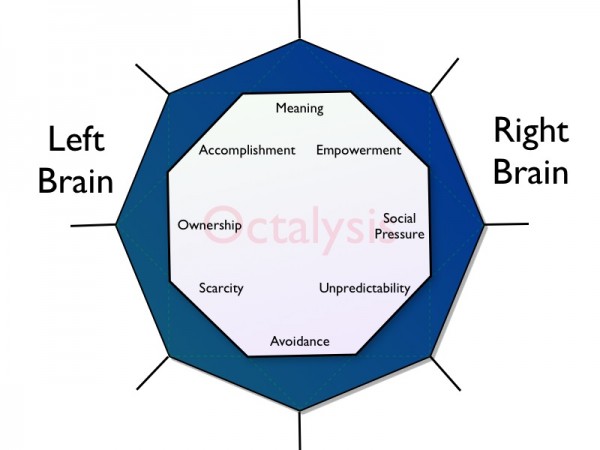
In a previous post, I discussed a general ideas of what gamification is. Before getting into the specifics of different game techniques, there’s one other part of the framework to understand. As I mentioned previously, I’ve used Yukai Chou’s Octalysis framework to help me with my understanding of gamification. In it, he explains the 8 Core Drives of gamification. Those 8 Drives have different natures that separate them into two different type of categories. The first division is the left-brain, right-brain Drives. The second is white hat, black hat Drives.
Left Brain, Right Brain1

As an educator, you’re likely familiar with the concepts of left-brain and right-brain thinking. It’s the same in gamification. The left brain is synonymous with logic and reasoning while right brain is more of the creative, emotional side. Additionally, they correlate with the two types of motivation: left brain with extrinsic motivation, right brain with intrinsic.
The Left Brain Core Drives are Drives associated with logic, reasoning, ownership, and analytical thought. These are the Drives that use external motivation, as they are driven by what a player may get in return. It’s the “What am I going to get if I do this?” types of motivation. These are often used for tasks that are not necessarily interesting as a way to motivate someone to do it. Grades would fall into this category. Students complete certain assignment not because they are interested in doing so, but because of the grade they will get for it. The 3 Drives that fit here are
- Drive 2: Development & Accomplishment
- Drive 4: Ownership & Possession
- Drive 6: Scarcity & Impatience
The Right Brain Core Drives are the Drives influenced by creativity, social connections, and curiosity. These are the more intrinsic motivators in which players are motivated for the inherently enjoyable experience of the task. These are the kinds of things would do without having to worry about what they’ll get in return. Think about a science lesson on gravity and wind resistance in which you ask students if a feather and a book can hit the floor at the same time. By sparking their curiosity and creativity on how it may be done, they may dive into the experiment without concern over a grade and find joy in the learning process. The 3 Drives that fit here are
- Drive 3: Empowerment of Creativity & Feedback
- Drive 5: Social Influence & Relatedness
- Drive 7: Unpredictability & Curiosity
White Hat, Black Hat2

The other two groups are White Hat and Black Hat motivators. These deal more with the way different motivators make us feel as a player.
White Hat Drives make us feel powerful, fulfilled, and satisfied. White Hat Drives give us control. This could include something like having students choose their own topic to research. By picking a topic of their own interest, they are more likely to be engaged in the research process. The White Hat Drives include:
- Drive 1: Epic Meaning & Calling
- Drive 2: Development & Accomplishment
- Drive 3: Empowerment of Creativity & Feedback
White Hat Drives are great motivators, but they do lack something critical: urgency. Students may be engaged in a choice they’re given, but if there’s no sense of urgency, then it won’t get done. That’s where Black Hat Drives come in. Black Hat Drives make us feel obsessed, anxious, and addicted. Something like setting a 10-minute timer to complete a task is a perfect example of Black Hat. Or the simple matter of getting a 0 for not turning in an assignment. Core Drives that utilize Black Hat motivation are:
- Drive 6: Scarcity & Impatience
- Drive 7: Unpredictability & Curiosity
- Drive 8: Loss & Avoidance
Black Hat creates some urgency to get the task done, but long-term reliance on this can have a negative impact on motivation. This would factor into why students who are constantly given zeroes on missing assignment will eventually lose all motivation for class.
Choosing with Purpose
The point in knowing all of this is to be able to purposefully choose what you’re using in your class and to understand how different techniques can be used to balance each other out.
For assignments and activities that aren’t thrilling, you might throw some right brain techniques like tracking daily or weekly streaks or providing badges or stickers for certain accomplishments. Turn quizzes or tests into boss battles that allow the class to earn bonus points. For other activities that are enjoyable for students, focus on left brain techniques. Maybe you don’t have to worry about a grade for a particularly engaging activity. Incorporate some social aspects that will allow students some interactions with peers. Give them the creative freedom to run with their ideas.
Black Hat and White Hat techniques need balance as well. You can give students freedom to work at their own pace (White Hat), but they can only unlock other tasks by completing certain requirements (Black Hat). Give students a set time to complete a task (Black Hat), but provide them an initial boost to get them going (White Hat). As the timer winds down, maybe throw in a random hint (White Hat) to keep struggling students going.
Again, the name of the game is purpose. Know why your using a technique to create engagement. If it doesn’t work well, embrace it as such and let it go. As you continue to evolve your techniques, you’ll find that you are able to build a more engaging classroom atmosphere.
Dig deeper into gamification principles; check out Yukai Chou’s book Actionable Gamification.
- Chou, Yukai. “Left Brain (Extrinsic) vs Right Brain (Intrinsic) Core Drives in Gamification.” Yu-kai Chou, https://yukaichou.com/gamification-study/left-brain-extrinsic-brain-intrinsic-core-drives-gamification/. Accessed 14 June 2024. ↩︎
- Chou, Yukai. “White Hat vs Black Hat Gamification in the Octalysis Framework.” Yu-kai Chou, https://yukaichou.com/gamification-study/white-hat-black-hat-gamification-octalysis-framework/. Accessed 14 June 2024. ↩︎
 The Educator's Quest